Email Security for Startups: A Complete Guide for UAE Businesses
This blog explains why email security for startups should protect more than the inbox. It covers phishing, business email compromise, account takeover, DMARC for startups, Microsoft 365 security, mailbox rules, domain authentication, and payment-related email risk. It further explains why UAE startups need clear proof of email controls when selling to larger buyers, preparing for vendor reviews, or improving essential security.
Email is still one of the most trusted systems inside a startup, and that trust is exactly what makes it so dangerous.
For UAE startups in particular, email risk often grows faster than the team notices. The business may be small, but the communication footprint is wide: customers across the GCC, suppliers, banks, free zone authorities, landlords, consultants, payment partners, logistics vendors, and outsourced teams.
Email becomes the place where business decisions happen.
That is why email security for startups should not be treated as only a filter that blocks spam. It should be treated as a control layer that protects money movement, account access, customer trust, and business continuity.
Managed email security starts with understanding the workflow
Most startups look at email security after something suspicious happens.
A fake invoice is received. A vendor payment instruction changes. A founder gets an impersonation email. A user enters Microsoft 365 credentials into a fake login page. A mailbox starts sending strange replies. Someone finds an auto-forwarding rule that no one created.
By then, the problem has usually moved beyond the inbox.
For a UAE startup, the first step is to understand which workflows depend on email. Finance approvals, vendor onboarding, customer support, sales contracts, password resets, employee onboarding, investor communication, and product notifications all carry different risks.
Email security should be mapped to these workflows. A finance mailbox needs stronger impersonation controls. A support mailbox needs attachment and URL scanning. Founder and executive accounts need VIP protection. Product notification domains need proper authentication. Shared mailboxes need ownership and review.
If every mailbox is treated the same, the control will miss the way the business actually works.
Phishing is only one part of the email problem
Phishing is still common, but it is not the only risk startups need to address.
Business email compromise is often more damaging. These attacks use trust instead of malware. The attacker may impersonate a vendor, monitor a mailbox, change payment details, or reply inside an existing thread after an account is compromised.
Account takeover is another issue. Once an attacker gets into a mailbox, they can search old invoices, reset passwords, read customer conversations, create forwarding rules, and use the account to target others.
There is also outbound risk. If your domain or mailbox is abused, customers and vendors may receive malicious emails that appear to come from your business. That can affect trust before you even understand what happened.
This is why email security needs more than inbound filtering. It should cover phishing, malicious attachments, URL rewriting, QR phishing, business email compromise, account takeover signals, mailbox rule abuse, outbound scanning, and domain authentication.
DMARC for startups is essential for email security
Many startups leave DMARC for later because it exists within the DNS and feels too technical.
That exact delay creates risk.
Your domain is used for sales, support, invoices, password resets, marketing campaigns, and customer communication. If attackers can spoof it, they can send fake emails that look like they came from your company.
DMARC, SPF, and DKIM help prove which systems are allowed to send email for your domain. For a startup, that may include Microsoft 365, Google Workspace, a CRM, a marketing tool, a billing platform, a support desk, and product notification systems.
The issue is rarely the concept. The issue is execution.
Many companies start with DMARC monitoring and never move forward. Others enforce too quickly and break legitimate email. A proper DMARC path should identify all valid senders, fix SPF and DKIM issues, review failure reports, and move toward quarantine or reject when the environment is ready.
For UAE startups selling to larger buyers, DMARC also becomes part of trust proof. It shows the business is protecting its domain and reducing impersonation risk.
Microsoft 365 security still needs hardening
Many startups assume Microsoft 365 security is handled because they are paying for the license.
That assumption is risky.
Microsoft 365 needs configuration review. MFA should be enforced, especially for admins. Legacy authentication should be blocked. Risky sign-ins should be reviewed. Mailbox forwarding rules should be monitored. Admin roles should be cleaned up. External sharing and OAuth app permissions should be checked.
Email attacks often become identity attacks. A phishing email may lead to a stolen password. A stolen password may lead to mailbox access. Mailbox access may lead to customer fraud or data exposure.
Email security and identity security have to be reviewed together. Treating them separately leaves gaps between the controls.
What mature email security for startups should look like
For a startup, email security maturity should not be judged by whether a tool has been purchased. It should be judged by whether the business can prove the inbox is protected, monitored, and tied into response.
A mature email security baseline should show:
- Inbound protection: phishing, malware, malicious URLs, QR phishing, and suspicious attachments are detected and blocked.
- Impersonation control: executive names, supplier domains, lookalike domains, and payment-related emails are reviewed with stricter rules.
- Account takeover visibility: suspicious logins, mailbox rule changes, impossible travel, and abnormal sending patterns are monitored.
- Domain authentication: SPF, DKIM, and DMARC are configured, reviewed, and moving toward enforcement.
- Quarantine governance: blocked emails are reviewed without creating blind allow lists that weaken protection.
- Outbound protection: compromised mailboxes and domain abuse are detected before customers or vendors are affected.
- Response ownership: alerts are triaged, escalated, and explained in language the business can act on.
This is where email security becomes a business control. It should produce evidence, not just alerts.
Why email security matters more when upselling
UAE startups often grow by selling into larger customers: banks, real estate groups, logistics companies, healthcare businesses, enterprise buyers, and government-linked entities.
These buyers may ask how email accounts are protected, whether MFA is enforced, whether domains use DMARC, whether phishing controls exist, and whether incidents are reviewed.
A startup may have a strong product and still lose momentum if the security answers are unclear.
Email security supports sales because it protects the communication layer buyers depend on. It also helps with vendor onboarding, cyber insurance conversations, compliance readiness, and internal governance.
A serious buyer does not want to hear that “the IT guy checks it sometimes.” They want evidence that controls exist and are being reviewed.
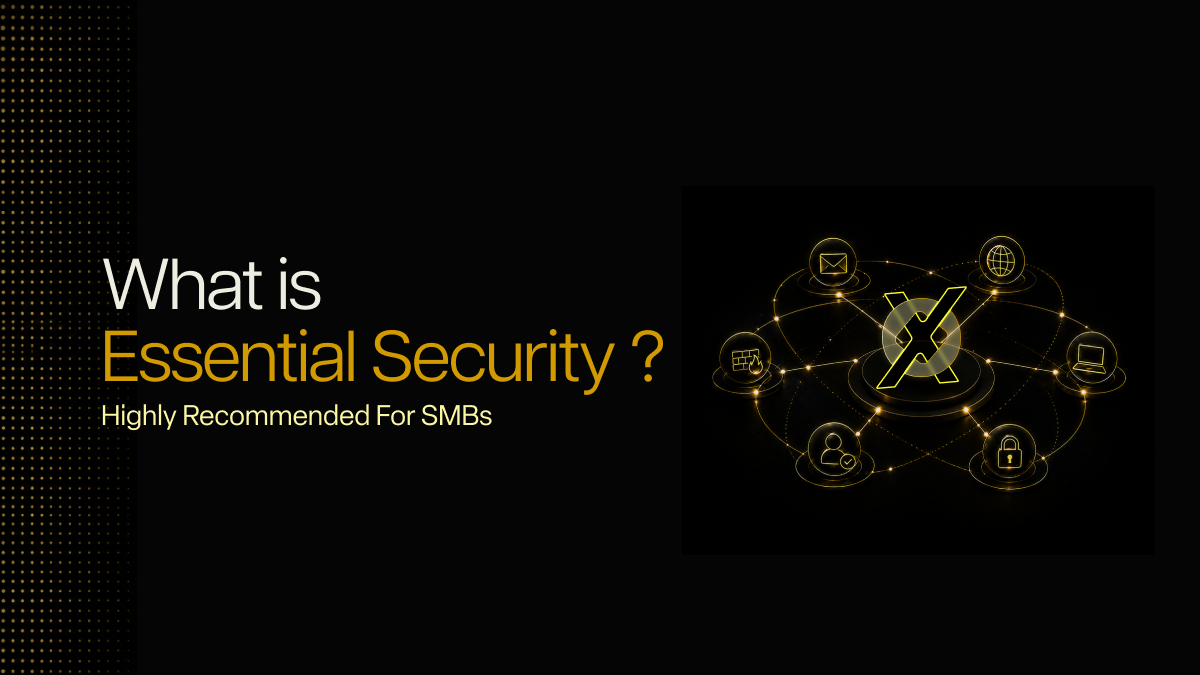
Email security should connect to the essential security baseline
Email security is one crucial part of a larger security ecosystem and simply should not exist in a vacuum. A malicious link may lead to credential theft, or a compromised mailbox could expose files in Microsoft 365. Maybe a fake invoice could trigger catastrophic financial loss.
That is why email security should be reviewed alongside identity, endpoint protection, DMARC, firewall hygiene, backups, and detection and response.
This is where many startups struggle. They buy tools, but the controls remain disconnected. And that gap is exactly where risk continues to exist.
Where Lumora fits in
Lumora helps startups and SMBs assess email security as part of the wider essential security baseline.
Through the Essential Security Review, we check whether email protection is configured, monitored, and connected to identity, endpoint, domain, backup, and access controls. We review Microsoft 365 settings, MFA coverage, mailbox rules, admin roles, DMARC status, endpoint protection, firewall hygiene, backups, and risky access paths.
For businesses that need ongoing support, Lumora X brings trusted products together to provide essential security with clarity model, including Microsoft 365 security checks, Fortinet-led email protection, Sophos endpoint protection, PowerDMARC domain protection, Acronis-backed recovery support, and Lumora’s monitoring layer.
Managed email security should give clear answers: which mailboxes are protected, which domains are authenticated, which users are risky, which alerts were handled, and which gaps should be fixed first.
If your business is unsure whether its email layer can stand up to buyer review, account takeover, payment fraud, or domain spoofing, Lumora’s 72-hour Essential Security Review can show what needs attention before one email becomes a business problem.




.avif)