A Practical Guide to Cyber Risk Assessment for Enterprises in the UAE
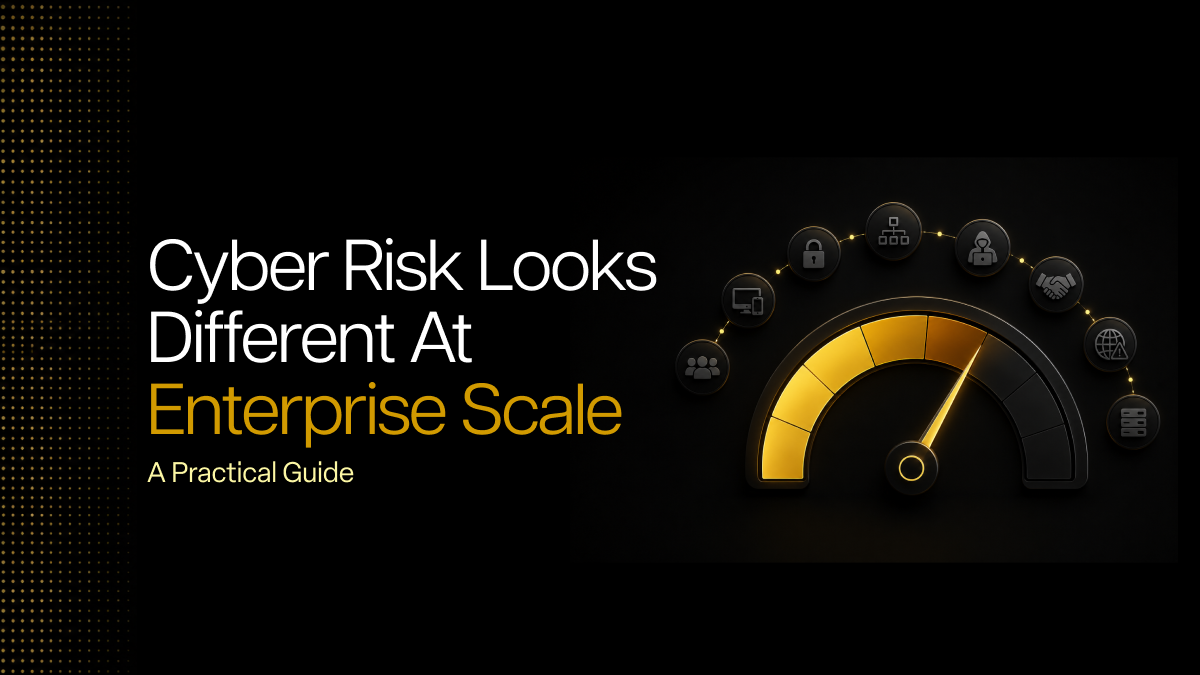
Enterprises in the UAE need a cyber risk assessment to understand where their real exposure sits across internal systems, users, cloud environments, vendors, applications, and external threats. Risk assessment covers different types of assessments, including vulnerability, cloud security, application security, privacy impact, vendor risk, and continuous risk assessment. It also explains how regulated and non-regulated enterprises face different levels of security and evidence requirements, as well as the unique challenges enterprises face when conducting cyber risk assessments of their own.
When an enterprise gets a cyber risk assessment wrong, the cost is rarely just a technical shortcoming. Unlike SMBs, any exposure at the enterprise scale is rarely contained to a single system: a weak point in one place can reach across regions, subsidiaries, supplier connections, and the shared platforms that tie them together.
A cyber risk assessment maps where an organisation is exposed and what the damage would be if each gap were exploited. For a small business, that map fits on a page. For an enterprise running thousands of users and hundreds of applications across cloud and on-premise systems, often under more than one regulator at once, the map is a living document that has to stay current. You run the assessment to know your real risk before an auditor or an attacker finds it for you.
Internal & External Risk - Multiplied by Enterprise Security Scale
These two categories are the same as anywhere. Internal risk lives in your own environment and external risk comes from outside it. What changes at enterprise scale is sheer surface area. Internally, you are securing acquired companies still running their old systems, business units that make their own IT decisions, privileged accounts spread across departments, and legacy applications nobody wants to touch because something critical depends on them. Externally, you are a bigger and more patient target. Attackers research enterprises for months and often get in through a third party rather than the front door.
The list is longer than you think
A smaller cyber risk assessment might cover endpoints, email, identity, and a firewall. An enterprise assessment covers all of that and keeps going further with the following:
- Cloud configurations spread across more than one provider
- Operational technology on factory floors and in facilities
- Data moving between subsidiaries that each sit under different privacy rules
- Application security for software your own teams built
- Third-party and supplier access, now behind a large share of breaches
Each of those is effectively its own assessment, which is why enterprise reviews run for weeks and pull in specialists instead of a single generalist.
To learn more about how SMBs conduct their cyber risk assessments in comparison to enterprises, here’s a practical guide on the subject.
Downtime Raises Cyber Risk for Enterprises
For an enterprise, a single hour of downtime can run into millions in lost revenue and contractual penalties, before the reputational damage even lands. That changes how the assessment is run. You cannot take core systems down for testing in the middle of a business day, so testing gets scheduled around maintenance windows or run against replica systems so nothing critical goes dark. The assessment also has to measure recovery. It needs to show how quickly each critical service comes back online, because for an enterprise that number has to stay small. The more stakeholders there are, the more accountability is needed for any kind of setbacks.
An enterprise assessment tends to be an expansive process, pulling in security, legal, compliance, the heads of each affected business unit, external auditors, and often the board of directors if the situation is severe enough. Every one of them has a stake, and every extra stakeholder adds time. Sign-offs take longer and findings get debated. A recommendation one team considers obvious gets blocked by another that owns the budget.
Coordination is what stretches an enterprise assessment from weeks into months. Planning for it early, by agreeing who decides what before the work starts, keeps findings from dying in a slide deck.
Review Cadence is Critical for Enterprise Security
An enterprise rarely has the luxury to assess their risks once a year and be fine. In this case, review frequency is usually set for them and shaped by the following factors:
- The regulators you answer to (Dubai Financial Services Authority, Central Bank of UAE, Abu Dhabi Global Market, or the UAE Information Assurance standards)
- Continuous-monitoring duties on your most sensitive controls
- Event-driven reviews after a merger or a major system change
- Reporting obligations under the UAE Personal Data Protection Law and Federal Decree-Law No. 34 of 2021
For most enterprises, a point-in-time assessment is only the starting line, and staying compliant depends on monitoring that never really stops.
The Challenges with Conducting an Enterprise Risk Assessment
Enterprise risk assessments are useful, but they are rarely simple in the UAE. A few issues usually complicate the process but are nevertheless vital when conducting any operations at this scale. These include:
- Stakeholder management: Risk does not sit with one team. IT, security, legal, compliance, finance, HR, procurement, business units, and vendors may all own different parts of the answer. If ownership is unclear, the assessment becomes a document chase.
- Regulatory overlap: UAE enterprises may need to consider cybercrime laws, data protection requirements, sector rules, customer contracts, and internal governance at the same time. That makes scope control important.
- Third-party visibility: Many UAE businesses depend on outsourced IT, cloud providers, payment partners, consultants, and regional suppliers. Assessing internal systems alone will miss real exposure.
- Fast-moving threat pressure: The UAE has seen organised ransomware, phishing, and infrastructure-focused attack attempts. This is compounded even further when regional geo-political conflicts flare up, which again raises cyber risk in the UAE. That means risk assessments cannot only look at historically effective controls but will need to adapt to consider current and evolving threat patterns as well.
- Asset and access sprawl: Enterprise teams often have cloud workloads, legacy systems, SaaS tools, shared accounts, privileged users, and regional operations. Getting a clean view of what exists and who has access is often the hardest part.
Ultimately, effective enterprise security works only when these challenges are managed upfront.
Where Lumora Fits
A cyber risk assessment should not leave an enterprise with a thick report and no clear next step. Its value is in the decisions it lets you make, and at enterprise scale that gets lost easily, because a review can satisfy every auditor in the room and never turn into action.
For many enterprises, that clarity is missing. They have layers of security tooling across business units and regions, but no single view of how those controls hold up together or where the real risk concentrates.
That is why Lumora takes enterprise cyber risk assessment head-on and brings essential security with clarity into the process. We run our Essential Security Review on NIST CSF 2.0, the same structure large organisations already use, and we map both internal and external risk against that recognised baseline. Because size brings downtime and cadence pressures, the review pairs with continuous monitoring through the Lumora MSSP Fence, so a snapshot becomes an ongoing picture.
The output is a prioritised action list and required budget you can hand to your IT, security, finance, and audit teams and start working through. You walk away knowing where you actually stand and what to address first. For a regulated enterprise, that is defensible evidence for auditors and the board. For everyone else, it is the clarity to act where doing nothing quietly becomes the most expensive option you have.
If your enterprise is not sure where its cyber risk actually concentrates across its operations, get in touch with Lumora for a clear assessment of your current security baseline and a practical path to close the gaps before they turn into board-level problems.



.avif)